
Flexibility and Low Conversion Costs Thanks to Rieter

The winding machine Autoconer X6 is now equipped with a Cop Exchanger that automatically rejects defective cops. This ensures fewer interruptions, reduces the workload for personnel, and keeps quality and performance at a consistently high level. The new, compact machine design simplifies both operation and integration into existing buildings.
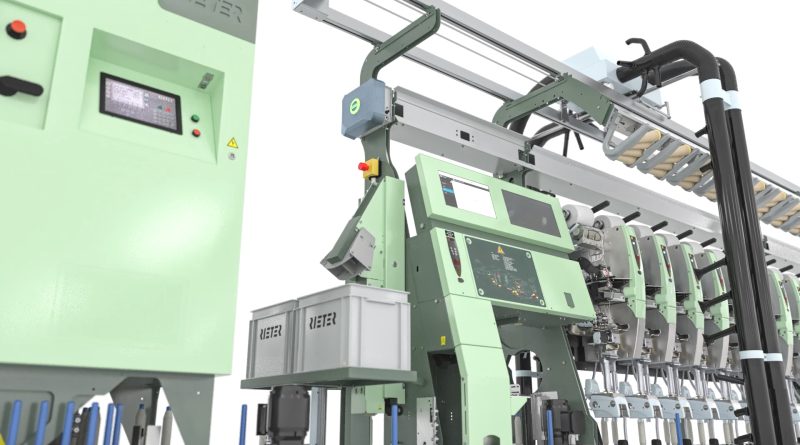
Customers with a high degree of automation rely on the Autoconer X6 Type V with its direct connection to the ring spinning machine. The current version now offers a Cop Exchanger that automates manual rejection of defective cops (Figure 1). This feature increases process reliability and improves quality.
Automated rejection
The Cop Exchanger works based on the SPID spindle identification system. It detects faulty yarn, known as alarm cops, and cops that are still tolerated but of below-average quality, which are known as off-standard cops.
In addition, sensors in the automation modules detect the processing status of the cops and identify those that cannot be processed, for example. SmartTrays and RFID technology help to move all the cops through the material flow with systematic precision. According to the recorded data, the Cop Exchanger automatically removes the affected cops from the process and sorts them into two separate containers. It then attaches an empty tube.
Maximum process reliability
Further advantages of the Cop Exchanger are its ease of use and flexibility. It has a high empty tube capacity and allows for two batches with the same tube length to be processed in parallel. Its containers are very easy to change. Customers also benefit from maximum process reliability. For example, the familiar decentralized material flow concept allows for combination with tube cleaning and a color check to monitor the tube color and ensure correct assignment to the corresponding SmartTray.
Space-saving design and improved ergonomics

Figure 2: The Autoconer X6 has a compact and ergonomic design
The new, more compact machine design improves space efficiency in the spinning mill for all machine lengths – right up to the longest versions with 96 winding positions. This feature is particularly important when integrating the machine into an existing building. This means that the more compact energy unit saves space. It also means that a section now consists of six or ten winding positions instead of four or six as before. This fact reduces the machine length by 350 to 818 millimeters.
As part of the redesign, the developers also optimized the machine’s ergonomics and ease of use: the operating height at the winding unit is now 80 millimeters lower. This makes the operator’s work safer and significantly more comfortable. With its new color scheme, the Autoconer now matches the Rieter ring and compact-spinning systems perfectly.
About Rieter
Rieter is the world’s leading supplier of systems for manufacturing yarn from staple fibers in spinning mills. Based in Winterthur (Switzerland), the company develops and manufactures machinery, systems and components used to convert natural and
man-made fibers and their blends into yarns in the most cost-efficient manner. Cutting-edge spinning technology from Rieter contributes to sustainability in the textile value chain by minimizing the use of resources. Rieter has been in business for 230 years, has 18 production locations in ten countries and employs a global workforce of around 4 400, about 15% of whom are based in Switzerland.
The post Flexibility and Low Conversion Costs Thanks to Rieter appeared first on Indian Textile Journal.