
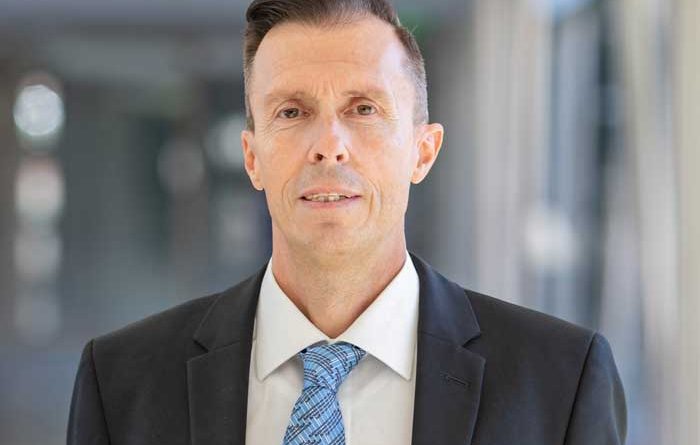
Renato D’Agostino: India is and will remain a key pillar of our global footprint

Groz-Beckert is strengthening its position in India’s fast-evolving weaving landscape with a sharper focus on performance-driven solutions, customer-centric innovation, and long-term market commitment. With rising loom speeds, demanding yarn qualities, and increasing pressure to reduce defects and downtime, the company is expanding its offering beyond conventional accessories. The launch of its Comprehensive Reed Portfolio reflects this larger strategy—combining engineering precision, application-specific customisation, and strong after-sales support aligned with India’s growth potential, says Renato D’Agostino – Global Head of Sales, Weaving Division, Groz-Beckert, in this interview.
Congratulations on launching the Comprehensive Reed Portfolio in Ichalkaranji. Can you share what gap in the Indian weaving market this new portfolio aims to address, and how it differentiates from existing solutions?
The Groz-Beckert Reed Portfolio addresses a clear gap in the Indian weaving market: the need for high‑performance, application‑specific reeds that can keep pace with rising weaving requirements.
While the market is growing rapidly, we see that today’s weaving mills face increasing pressure from higher loom speeds, more demanding yarn qualities, frequent style changes and rising cost sensitivity. Standard or commodity‑type reeds no longer meet these expectations.
Our reed portfolio is designed specifically to close this gap. It focuses on delivering stable high‑speed performance, sustainable fabric quality and reduced overall weaving cost. By engineering reeds around concrete customer challenges—such as airflow issues, instability at higher speeds, dent irregularities, wear, rusting and short lifetime—we provide solutions that directly improve efficiency, reduce defects and boost machine uptime.
What differentiates our portfolio from existing solutions is the combination of:
- Engineering‑driven, non‑commodity reed designs tailored to real customer pain points.
- Application‑specific customization, such as optimized airflow configurations for higher efficiency, special reinforcements to ensure stable high‑speed operation with fewer breakdowns, CNC‑controlled reed binding for maximum accuracy and precision, and our in‑house high‑performance DLC coating for highly abrasive applications
- A focus on total weaving cost, not just piece price—extending reed lifetime, reducing waste and supporting stable production.
- The broadest portfolio in its class, covering flat reeds, airjet reeds, fine reeds, specials and warp‑preparation combs — complemented by the full Groz‑Beckert weaving accessories range and weaving preparation machinery.
In short, the Comprehensive Reed Portfolio brings together performance, fabric quality and economic value, helping Indian weaving mills operate more efficiently in a market that is changing faster than ever.
What inspired Groz Beckert to choose Ichalkaranji as the location for this launch, and how does it fit into your India-specific growth strategy?
Absolutely—Ichalkaranji was a deliberate and strategic choice for this launch.
For many years, the region has been one of India’s fastest‑growing weaving hubs. Mills in Ichalkaranji have consistently invested, modernised, experimented with new markets and adapted to rising technical demands. In our view, any weaving solution that proves its performance in Ichalkaranji can succeed in virtually every other textile region of India.
This makes the city an ideal benchmark location for introducing a portfolio as technically comprehensive as ours.
From a strategic perspective, Groz‑Beckert aims to deepen its presence across all major textile clusters in India. We operate a truly unique sales and service network—teams who are on the road every day, close to the mills, understanding needs first‑hand. Launching the portfolio in Ichalkaranji strengthens this approach: success here resonates far beyond the region. It signals to other markets that Groz‑Beckert is committed to bringing high‑performance weaving solutions to India’s most demanding and dynamic clusters.
In short, Ichalkaranji is not just a location—it is a statement. A successful launch here reinforces our India‑wide growth strategy and underscores our long‑term commitment to the country’s weaving industry.
With the Indian textile industry rapidly evolving, how does Groz Beckert plan to support customers here in terms of after-sales service, training, and local innovation?
Certainly. Supporting customers beyond the product itself is a core element of our strategy in India.
Groz‑Beckert has been active in the Indian weaving market long before the introduction of our reed portfolio. Customers who seek expertise typically find it first through our sales team—professionals who are not only commercially experienced but also technically well trained and deeply connected to the day‑to‑day realities of weaving mills.
As demand for high‑performance reeds grows, we will continue expanding our structures step by step in line with customer needs. This includes decentralised stocking options, specialised service teams and stronger on‑site support. For our weaving preparation machinery and existing accessory lines, we already offer comprehensive after‑sales service throughout India. Our goal is to build the same service depth and reliability for the reed portfolio as well.
What truly differentiates Groz‑Beckert in the Indian market is the integrated approach we bring: market understanding, sales, application expertise and service—all under one roof, for all our product lines. This allows us to respond faster, support mills more holistically and ensure consistent quality from installation to long‑term performance.
When it comes to innovation, our philosophy is clear: we work as closely as possible with customers. Their expectations, challenges and pain points are the only relevant starting point for new developments. Innovations designed in isolation, without real-world validation, are not part of our culture. We believe progress happens on the shop floor, together with the mills—not behind closed doors.
Looking at your global footprint, which markets are showing the strongest demand growth for weaving components, and how does India compare?
The global weaving landscape has evolved dramatically, and today the dynamics are fundamentally different from even a decade ago.
For many years, the industry operated under a model where Europe and the US set the benchmarks while Asia primarily acted as an extended manufacturing base. Those days are long gone. The only segment still anchoring parts of weaving in Western markets is technical textiles—yet even this segment is gradually shifting toward Asia.
At the same time, even Asian markets are experiencing a growing reluctance among younger generations to work in traditional textile factory environments. This structural shift will continue, but given the sheer scale of the markets, weaving will remain an essential industry across the region.
China remains the world’s largest weaving market. However, we clearly observe production moving either deeper into inland provinces or even across national borders into Southeast Asia. In that sense, the “Chinese weaving market” today is effectively distributed across several Asian countries.
India, by contrast, stands out as the textile market with the strongest long‑term development potential.
India combines several factors that are increasingly rare in the global textile economy:
- A huge domestic consumer market
- Strong export capabilities
- Deeply rooted weaving know‑how built over centuries
- A stable political framework that encourages investment
- Rapid improvements in education, training, infrastructure and industrial modernisation
- A growing societal confidence in “Made in India”—a mindset shift that is essential for sustainable industrial growth
- Own raw material cotton
Even though geopolitical uncertainties may temporarily slow momentum, India’s structural strengths remain intact. The industry has a clear sense of its creative, technical and economic capabilities.
For Groz‑Beckert, this makes India much more than just an important sales market. We are proud not only to supply high‑performance weaving components but also to manufacture products from several business units locally at our site in Chandigarh. India is—and will remain—a key pillar of our global footprint.
The post Renato D’Agostino: India is and will remain a key pillar of our global footprint appeared first on Indian Textile Journal.